My Very Own Library Card!

left work and went by the post office to mail the truth
to my mom. she doesn’t understand that her poodle, cooki, is a bad girl
dog. i mean, the dog is a demon creature with red devil eyes way scarier
than any goat. so with the truth in the mail, i accomplished one of my
remaining to-do’s for the week—no doubt the change of the week! (note
that you have to have changes if you’re creating a changelog)

this will sound dumb to anyone with a real life, but today, this very
evening, all by myself, i got a library card! i am now a card-holding
patron of the champaign public library. ok, it’s true that as a fun-filled
employee of NCTE, an affiliate organization of the University of Illinois,
that i can use the u of i library whenever i want. but who the hell wants
to figure out parking on campus to get some picture books?

so public library you are my goal, but, wow, have things changed in libraries
since i was a page at chesterfield county public library back in high
school. then again, that was twenty-thr, er, a few years ago. there was
a wild game of chase going on in the picture books. all computer terminals
were being hogged for video games. and there was a group of teens supposedly
playing candyland, but making so much noise that the security badge guy
had to come over and ask them to hushinate.

what a darned shame eric wasn’t around! he could have just sauntered over
and glowered with that Dwight
D. Eisenhower Statuary Stance
(TM) and the hush that would have fallen
over the room would have been adequate for papal mumblings to be loud
as a foghorn.

oh well. i minded my own business and fetched books and stuff. i scooped
up three cds (Aladdin and the Magic Lamp with John Hurt and Mickey
Hart, Brer Rabbit and the Wonderful Tar Baby with Danny Glover
and Taj Mahal, and Brer Rabbit and Boss Lion with Danny Glover
and Dr. John). plan to listen to them while walking. then i meandered
over to the picture books. got June 29, 1999, which i want to create
a lesson for that we’ll hook up to the calendar
on the site. besides Wiesner’s books are always so lovely to look at.
got Jumanji for a tech writing lesson plan we have in the works,
by Erin Crisp. she has students writing the instructions for a game, and
after all, in Jumanji it’s so-o-o-o important to "read instructions
carefully" : )

then i got four books on monsters! for another lesson plan. i own sendak’s
wild things, so i didn’t get that. with the librarian’s help, we found
Nothing Scares Us, Go Away, Big Green Monster, It’s Bedtime,
and Five Ugly Monsters (which is strangely like Five Little
Monkeys
). we have a lesson proposed on using monsters to teach about
writing detailed descriptions.

it’s my job to think up an ‘interactive’ for each lesson. understand that
‘interactive’ has a special definition. pdfs count as interactives. though
the more ‘interactive’ an interactive is the better. for the monsters,
i was thinking about the silly Fraser
the Eraser "rub-a-dub-dub" BBC monster
, and then mr. potatohead
danced through my head, and i thought that maybe I could create a "monster
machine." sort of a cross between magnetic poetry and mr. potatohead.
ok, maybe not that original. we’ll have to see.

i’m not sure about the interactives for the other two books i have. i
guess it wouldn’t be too difficult to come up with some ‘follow the instructions
or things go horribly wrong’ thing. but how do you make things go wrong
on the Internet? well, what i mean is how do you make them go wrong in
ways that allow you to keep a job in k12 education?

enough on my day occupations though. i should get back to the brainclogging
blogging that gravel-lord rich wants me to do. sigh…

Broken Links

wow. it’s been over three whole hours since i found an excuse
to do this instead of doing something else. A-M-A-Z-I-N-G!

wrote the report on the fascinating broken links. checked all the pdfs
on the site for the logo, and added
lots of cute graphics to the latest lessons (my favorite is the goose
on the Mother
Goose lesson
. i mean, how could you not like a goose? well, actually,
now that i think of it, you could not like a goose. when
my younger brother was three, my grandmother had some geese penned up
behind the barn and when no one was watching, Noel was apparently doing
some animal behavior study. he came running, crying loudly, but wouldn’t
tell us what was wrong. when we finally calmed him down, he tells us,
"goose bite my finger." i guess in these instances, one might
have good reason not to like a goose. but really, a little goose never
hurt anyone.)

hmm, eric has written that he’s reading this. hmm. i fear that he stands
before his computer in the Dwight
D. Eisenhower Statuary Stance
(TM) scowling. he’s probably just getting
jealous of rich though. as soon as i return to writing about him, he’ll
be ok.

oops. my officemate just asked what i’m working on "because you’re
typing like a mad woman," she says. um. guess that’s a sign to get
back to work, before she finds out what i’m really working on.

1/13 Journal

ok, so now i’m procrastinating at work. i just got done fixing all the broken links that i’m responsible for at readwritethink. now i have to write the report that says i’ve done it. rich called a little bit ago to talk about blogging and gravel and stuff.

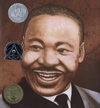
Musing on Martin’s Big Words

got loads of cleaning and organizing done, though no real
writing. looking for some kind of small magnetic board for the office,
but all i seem able to find are big magnetic white boards. not exactly
the ideal solution

have been thinking about the MLK lesson plan that i’ve been
working on. letting it simmer mainly. i’m still sort of between feeling
unsure if it’s a useful lesson or just a lesson with a social agenda without
any other real purpose. i
have it has a 3-5 lesson focusing on the Martin’s
Big Words
book. have students talk about the notion of ‘big’ words
and then go out to choose their own ‘big’ words. the other alternative
is to give them MLK quotes and have them choose ‘big’ words which they
compose into a found poem, or something of that sort. i dunno. maybe it’s
just that the theory section seems so gaggy to me right now:

To talk about Dr. King’s life is to talk about horrible
things: racism, bombings, murders, assassination. Yet it is also to
discuss wonderful things: love, peace, harmony, pride, determination.
What do we tell children about the "bad" things in the world?
How can we "give [them] hope… provide [them] with reasons to
embrace life and its possibilities" (Stanley 41)?

Ultimately, Stanley resolves, "Education is the only solution
that I know to these dilemmas. Education, understood not as technique
or training, not as schooling, but as part and parcel of ‘the engagement
of being human,’ i.e., the shared act of making meaning of meanings
inherited from others" (41).

Following the terrorist attacks of September 11, 2001, the NCTE Executive
Committee issued a statement
that concluded similarly: "We assert that the long-term response
to violence and cruelty — indeed the only truly effective response
— is education, an education in which social justice and the dignity
of all people are held paramount."

In this activity, students focus on this kind of educational goals.
Through an exploration of Dr. King’s use of non-violence protest and
the power of words as a weapon for social justice, students learn
more about Dr. King’s life and think about their own impact on the
future. And by turning from King’s words to their own hopes for the
future, the activity makes specifically highlights hope for the future.

Further Reading
Stanley, Timothy J. 1999. "A
Letter to My Children: Historical Memory and the Silences of Childhood."
Teaching for a Tolerant World, Grades K-6: Essays and Resources.
Ed. Judith P. Robertson. Urbana: NCTE. Pp. 34-44.
     Stanley’s article focuses on talking
to his children about whether Nazis are "bad guys." While
not directly about King or African American history, the piece is
a relevant discussion of the things that we do and do not talk to
children and students about, when we discuss the, how we discuss them,
and why we discuss them.

i dunno. it’s ok i guess but it feels so PC instead of sounding like me. it’s like i’m not even there. some stuffy theory paraphraser is. or maybe the problem is that i’m trying to justify teaching MLK rather than why we’re teaching about the idea of "big" words and such. i don’t have to finish it till at least tomorrow.

Unpacking

finally slept. have been working on laundry, unpacking, cleaning. wrote to rich this morning about quoting from his email. i’m not sure what i’m writing here. personal ramblings. maybe they don’t belong online. of course, that’s why i want to dig into what rich is saying, details at blogger, and so on. but for now, i need to get back to unpacking and such.

When You Can’t Sleep

i wonder if people who can sleep through the night appreciate how lucky they are. you really have to go through the endless nights of waking up every two or three hours. and the long gaps spent trying to fall asleep. trying to situate your arms and hands and legs so that they won’t creep into uncomfortable positions and wake you any sooner than you’ll already waken.

so this time i’m out of bed, i unpacked some more stuff, the candles essentially. they’re in the bottom of the china cabinet. now if i could only get the china unpacked from the boxes it moved here in three years ago. i must have the slowest progress of anyone i know. though if you count the fact that i get out of bed every two or three hours and unpack something perhaps you can say i’m at least persistent.

i feel almost like macbeth. just without the guilt of murdering folks. i have plenty of guilt–that chapter promised to mday that will likely never materialize, book proposals promised to pete, unwritten letters, unwashed clothes, undone to-dos. i’m just not murdering folks. i’ll go back to bed, and tasks i can’t even think of now will begin marching through my head, telling me how simple they would be to write, to accomplish. i do a thousand things in those moments when i’m not asleep, lying there in the bed and make plans to do a thousand more. so simple they seem and yet when i get up, as hard to accomplish as sleep is to find.

Sleeping, Writing, Thinking

i hate when i can’t sleep. ok, partly, i have a headache; but also, i’m just lying in there thinking about all the things that i should be writing and am not. when i come out to the keyboard are any of those brilliant sentences still in my head? of course not. i can’t even completely remember what the sentences were about. i guess one of the more important things was trying to figure out how to explain what on earth i’m doing here. writing this stuff that is. i want to refer to an email rich sent me, but i need to write him and ask if it’s ok. writing that would require way more concentrating than i want to do right now though. hmm.

1/12 Journal

this is about the 3 millionth try at getting this page set up. today was my great-grandmother’s birthday. maybe that means i can run out to the store tomorrow and buy birthday cake and celebrate. well, or, i could work on the 15million things on my to-do list. and it’s been what? months and months since a list of ten. i need to get my technotes on here too. but it’s bedtime for now.

01/11 Journal

ok, i really needed to do something about my homepage, but i also need to unpack some stuff from vacation. but i’d much rather sit and poodle around with web pages. so….

Traci’s 1st List of Ten: Ten Ways to Ask Students to Re-Think the Classroom

Originally Posted July 1, 1998 to ACW-L, WCenter, NCTE-Talk, and TEACH and at the Daedalus Website

  1. Place your students in the future. It’s the year 3098. A team of archaeologists discovers your classroom, exactly as it is now. What do they make of their discovery? How do they describe the space? What do they imagine happened in the place? How do they support their findings–that is, what things in the space support their conclusions? Students could form teams (writing groups) and work in online InterChange conferences to gather ideas about the space. They might write a group paper or individual papers reporting their findings to the organization that funded their archeological dig. Or they could write a “newspaper article” (whatever the equivalent to a “newspaper article” is in 3098). You might even ask them to write about their discovery as an email message to a friend or family member.
     
  2. Ask your students to work as ethnographers in the classroom–explain the idea of participant-observers, and have your students observe the community in your classroom. What social structures exist? How do members of the community interact? How do the physical structures in the classroom affect the community? By comparison, you might ask students to observe the ways that computers work in other places on your campus–what kind of community is built (or not)in public access computer labs, around workstations in the library, and so forth. Students might examine the differences: how does the community change, and why does it change?
     
  3. Make your students classroom designers. Give them carte blanche to rethink the set-up and layout of the room–move the desks, tables, machines, and so forth. Add equipment, furniture, and/or resources. If you have a drawing program on your computers, they might even sketch out their designs. After their rethinking, have students write a proposal to implement their changes–ask them to include an explanation of the changes they would make AND a detailed justification for the changes. For example, saying that they want to add a conference table to the room isn’t enough–ask them to explain why the conference table should be added and how it will affect the learning that takes place in the space.
     
  4. Enter an online discussion on the advantages and disadvantages of the computer-based classroom. Ask students to use pseudonyms–Your discussion should include campus administrators, teachers from other disciplines, family members, politicians, teachers from other schools, alumni, and students from other schools (including, say, high schools, other colleges, and so forth). You might assign roles or have students choose for themselves, but work for a range of aliases. Urge your students to think carefully about the point of view of the speaker that they represent. Before the online discussion, students might write position papers from their speakers’ point of view, to help gather their ideas and think through the opinions. You might use the transcript later–analyze the range of perspectives, revise the position papers based on the group discussion, and so forth.
     
  5. If your students are used to coming into the classroom, logging in (nearly or completely) on their own, and getting down to work, begin one day NOT on computers. As your students enter, tell them that you want them to wait so that you can make some announcements. Once it’s time for class to start, take a survey. How many students followed your instructions? What did those who followed the instructions do instead of working online? What did those who didn’t follow the instructions do? Move to an online discussion about student-centered versus teacher-centered learning. Encourage students to discuss the ways that they are responsible for their learning and how the computer-based classroom compares to the other classrooms where they attend classes.
     
  6. Have students choose a historical figure they are interested in. Give them a chance to do some background research on the figure, and then tell them that their figures have been plopped down in your classroom. Ask them to write a paper giving their figures’ analysis of and reaction to the space. You might set some parameters to help avoid papers gone wild with make-believe–the figures know, for instance, that the space is used for education. The point of the assignment is for students to think about the computer-based classroom from another point of view. Students might participate in online discussion, in the persona of their historical figure (see Robin Wax’s “History Comes Alive on the Little Screen,” NEA Today, Sept. 1994, p.25).
     
  7. Think of your school as a human body, where does this classroom fit? Where do other places, people, and organizations in the school fit?–assign your students a paper that explores where your classroom belongs in the bigger organism. Ask them to consider the ways that your computer-based classroom fits with other kinds of classrooms on campus, how your computer-based classrooms adds or detracts from the bigger whole, and so forth. If you don’t like the metaphor of the human body, try another: the school as an ecosystem, the school as a city, the school as a company, and so on. You might encourage students to choose their own metaphor for the school.
     
  8. Assign students the task of writing a letter to entering students at your school who will encounter your computer-based classroom for the first time. What can they tell these new students about the space and how it works? What information do they wish they had had when they first began using the classroom? You might combine this writing assignment with the student ethnography paper (#2, above) &#151 asking students to write their letters after having observed the space and thought about the community that exists in it.
     
  9. Turn your students into computers(metaphorically, of course). From the computer’s perspective, ask them to observe, analyze, and evaluate the humans in the room. If the assignment seems hard to get started on, appeal to popular culture. Ask students to assume a thinking persona for the computer in the same way that Star Trek: The Next Generation’s Data, Voyager’s The Doctor, or Lost in Space’s The Robot take on human qualities even though they are machines. Ask them to think about how the machine would evaluate the space. What role would the machine think it fills? What does it think of these humans who sit down in front of it? Papers might be first-person narratives on a day in the lifeform the computer’s point of view (“I was resting here happily, drawing fractals. I was sort of pleased with the fuschia one, and then I felt one of them reach over and move my mouse. Damn. They want me to work again. Don’t they understand how peaceful it is to sit and draw fractals?”), position papers (a computer writes, “Why I Should Be Networked”), or a reflective essay evaluating the roles that it has played over time (e.g., a hand-me down computer from the Math Lab reflects on the things it’s seen and the differences between the two labs it has lived in).
     
  10. Put your students in the future, looking back at your classroom. Ask them to imagine that they have come back for their ten (or twenty, etc.) year reunion. They run into one another and decide to find the old classroom. Miraculously, it’s still there (though it’s very likely to have changed greatly). For their assignment, ask students to reflect on their experiences in the place and to comment on how the computer-based classroom influenced their education (and the things they are doing now that they are graduates). The point is to ask them to think about what they think that they will value (or not) about having had a class in your computer-based classroom once they have moved on to other places and experiences. They might write their thoughts in the format of a letter or article for the alumni newsletter, or they might compose their reflections in a letter to a politician or campus administrator, urging more (or less) support for computer-based classrooms.