March of Time Newsreels in the Classroom

Film Canisters by Mr. T in DCBack in the days before 24-hour news networks, people went to their local movie theaters to see what was going on in the world.

The March of Time, perhaps the most well-known producer of these videos, distributed documentaries that covered everything from American culture and lifestyles, to business and industry, to the nation at war.

To celebrate the 75th anniversary of this precursor to breaking news videos on YouTube, the Museum of Modern Art has a special film exhibition, running September 1 through September 10. Turner Classic Movies has posted background information on The March of Time and will show five of the newsreels on September 5th.

Luckily, highlights from the collection of historical videos are also available online from HBO Archives. Note that a free site login is required to view the videos. Additional materials are also available from the March of Time’s Facebook page.

The newsreels and documentaries on the HBO site include historical events, cultural happenings, and biographical profiles. The videos provide a wonderful snapshot of life in America and around the world.

I first wrote about the March of Time collection on Bedford Bits last summer. You can check my blog entry Use Newsreel Videos for Background and Analysis there for specific ideas.

One of my favorite possibilities for class discussion this fall is the Oil and Men video, which offers a profile of Standard Oil of Indiana from 1951. What a great pairing that 30 minute video would make for videos and news stories on BP’s Deepwater Horizon oil spill.

Here are some others you may want to spend some time with:

  • Basic English 1, with text by I. A. Richards, is quite odd, though perhaps not the best “teaching picture.” There’s also a Basic English 2 if you survive the first video.
  • Tobaccoland, USA might pair nicely with an analysis of cigarette advertisements and anti-smoking commercials.
  • Leadbelly is a short biopic on the famous musician, which might be compared to profiles on celebrities shown on TV or in magazines like People.
  • Wit and Humor is a dramatization of Nathaniel Hawthorne’s short story “Dr. Heidegger’s Experiment.”

It’s unfortunate that HBO has left the running clock on the videos, but it’s still a handy collection with limitless possibilities for the classroom.

[Creative Commons licensed Flickr photo by Mr. T in DC]

6 Reasons Blogrolls Are Dying

Cinnamon Roll by stevendepoloI posted a message to TechRhet this weekend that I thought would yield a fast result. I needed to gather a list of comp/rhet blogs for a project, and I want to make sure I didn’t leave anyone out.

I asked readers to pass along links if they had a great blogroll or knew of some wonderful blogs I should include.

The response? One message. That’s it. One message that pointed to one blog.

So I began searching for the links on my own, visiting friend’s blogs and scooping up links as I went along. I quickly observed that blogrolls are a dying breed.

  1. Fewer people have blogrolls. There was a time when everyone listed every blogger possible in the sidebar. Not the case any more. More than 1/2 of the blogs I visited had no blogroll at all.
     
  2. Blogrolls tend to be an unordered list, which makes their usefulness questionable. Presented with a giant list of blogs, you have nothing to go by but the blog name or the writer’s name. Sorted into categories or with tags, the list would be easier for visitors to use. As they stand on most blogs, they seem to be a simple list of friends and colleagues in most cases.
     
  3. The blogrolls I did find were not well-maintained. The lists were littered with broken links, dead blogs (i.e., the link works but there hasn’t been a new post on the blog in months), and links to old blogs, with pointers to a new home.
     
  4. Gathering a blogroll (and checking its links) is a time-consuming project. There’s a reason these things aren’t maintained. The only way to make use the blog links all work properly is to sit and click on each and every one.
     
  5. Blogrolls are suffering because blogs have more competition these days. Many colleagues are foregoing blogs for shorter status updates. On more than one blog, I found a note that indicated the person was going to update via Facebook or Twitter instead of maintaining the blog.
     
  6. Follower and Friend lists are replacing blogrolls. When you click follow or okay a friend, you create a list of colleagues that is quite similar to a blogroll—and which is infinitely easier to maintain. They take care of themselves. You never have to chase down the URLs or check for deleted accounts.

Ultimately, I collected a list of nearly 70 blogs. Feel free to copy it for your own site or send links to anything I left out. I just won’t promise you that I’ll maintain it for the long term.


[Creative Commons licensed Flickr photo by stevendepolo]

What Are Kidwatching, Microblogging, and Podcasts?

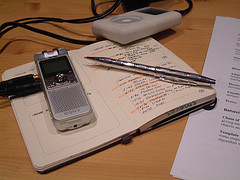
Writing a Podcast by Irish TypepadSoon NCTE will be launching an online site for members that will include many cool features, including an online glossary for English teachers.

My assignment this afternoon was to come up with 3 definitions to add to the collection as examples—and to make sure they were backed up in case they get accidentally erased. So here are my three rough drafts. What do you think? I’d love to hear suggestions to make them stronger!

Kidwatching Definition

Kidwatching, a term popularized by Yetta Goodman, is a way to record your students’ development by observing their behavior, strategies, and ways of making meaning. In the simplest explanation, kidwatching is exactly what it sounds like: watching kids—as they read, write, collaborate, and participate in your class—and taking notes on your observations of students’ effective use of skills, concepts, and strategies.

Observations alone can be useful; but what makes kidwatching a particular strong tool in the classroom is the step that teachers take to move beyond observations and note-taking to analysis and curriculum building based on on those observations and notes.

For more information, see O’Keefe, T. (1997). The Habit of Kidwatching. School Talk, 3(2). 4–5. [Available online at http://www.ncte.org/journals/st/issues/v3-2]

Microblogging Definition

Microblogging is an online publication method that allows writers to publish very short updates, typically in 140 characters or less. Tools used to post microblog updates include Twitter (the most popular tool), Jaiku, and Plurk. Status updates posted in Facebook can also be microblogs.

Microblog updates can touch many kinds of writing, from exposition to fiction and more. Twitter originally asked writers to post a response to the question “What are you doing?” The question has evolved to “What’s happening?” today. Microblog posts can include any of the following:

  • a status update on where you are and what you’re doing
  • comments and reviews on a book, movie, concert you’ve attended
  • links to pictures with short comments on their significance
  • pointers to websites, news articles, and other resources you’ve found valuable
  • questions and calls for suggestions (as well as related answers)
  • haiku (or Twaiku, as they are sometimes called) and other ultra-short poems
  • one-sentence stories

As far as the content is concerned, anything goes. What primarily defines microblogging are the length and its publication in an online forum.

Some teachers use microblogging assignments as part of their class activities, to share quick updates on class business and as a writing activity. See Profhacker’s Framework for Teaching with Twitter for additional tips if you decide to try microblogging with students.

Podcast Definition

Podcasts are serial audio or video recordings, posted regularly online. Some people call video podcasts vlogcasts. You might think of a podcast as a kind of blog that posts recordings (rather than webpages) on a regular basis. Some call any audio or video recording a podcast, but in the strictest technical sense, the word refers to episodic publications.

To listen to a podcast, you can either play it directly (streaming) on your computer or download the file and listen to it later (on your computer or on an MP3 player or smartphone).

Podcasts can be used for any purpose a text might serve—they can tell fictional stories, share and comment on recent events, inform listeners about a topic, and persuade listeners to take an action or adopt a stance. As a result, podcasts are valuable tools for teaching students to use spoken language to communicate effectively with a variety of audiences and for different purposes.

For more information on podcasts, see the ReadWriteThink strategy guide Teaching with Podcasts.


[Creative Commons licensed Flickr photo by Irish Typepad]

Activities That Ask Students to Explore Cultural Mindsets

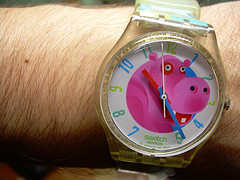
Wrist watch by sergis blogThis week’s release of the Beloit List got me wondering about how the resource might be used in class.

Officially known as the Mindset List of the Class of 2014, the Beloit List has been published each August for the last 13 years to remind us teachers of the cultural knowledge that first-year college students bring (or don’t bring) to the classroom.

This year, we’ve learned that the incoming class thinks Barney is a dinosaur rather than a Mayberry Deputy, telephones have never had cords, and wrist watches are not part of their wardrobe. Or at least that’s what the list wants us to believe.

The Chronicle of Higher Education published an article yesterday that explored the background of the list. Tom McBride and Ron Nief, “The Minds Behind the Mind-Set List,” explain:

the list started on a lark back in 1997—some old college hands unwinding on a Friday afternoon, musing on how much freshmen don’t know about recent history and culture. But such blind spots are to be expected, they had agreed, given the relative youth of the incoming class. They had concluded that professors should be mindful of how very different their students’ life experiences are from their own.

What struck me when I read The Chronicle article though was the picture of the lists creators. There they were. Two, white-looking, men. I couldn’t help but wonder how the lists might be different if the authors were, to put it politely, a bit more diverse.

What began as that little curiosity turned into this short list of ways that you might use the list in class:

  • Analyze the list for diversity. Think about race, gender, and ethnicity. What’s missing? How would you revise the list to be more accurate.
     
  • Consider the accuracy of the list. Take one of the items on the list and do a little research to see how correct it is. Anecdotal research and simple surveys would be enough. For instance, observe people in the library or dining hall and count the number who have on a wrist watch. Think of yourself as on a mission to bust myths and misconceptions.
     
  • Share your personal mindset, using the Beloit List as a model. What cultural markers do you consider important? Are there things that have always been a part of your life (or have never been)?
     
  • Create a list for a historical figure or fictional character. The list should clarify how the world of the figure or character is different from that of today. For instance, Chaucer’s pilgrims never had indoor plumbing and travel was normally by foot or by horse. Pop culture figures would work as well (e.g., characters from television series or movies).
     
  • Gather a list on the cultural mindset of a different social group—veterans who served in Afghanistan, working mothers, or firefighters, for example.
     
  • Refocus the list to outline 5 to 10 items that fit the topic “I live in world where . . .” Try to think of specific details that communicate how your world differs from that of others in the incoming class. Use the list to show how you’re different.
     
  • Satirize the list with an irreverent collection based on a more humorous touchstone. How about “ever since I got a job” or “since I’ve been on a diet”?

The language of the Beloit list is an easy model to follow, and many of these activities can be a fun community building activity.

And speaking of fun, I know it’s a terrible stereotype, but I really want to write a list that begins “Ever since we started dating, the cap has always been on the toothpaste, the toilet seat is always down, and my dirty socks are usually in the laundry basket.”

[Creative Commons licensed Flickr photo by sergis blog]

The Back-to-School Organization Bug

Desk supplies by Russ NeumeierI couldn’t figure out why i suddenly cared about the mess on my desk and the piles of papers sitting around this week. Why did it suddenly matter?

I did think it funny that the printouts at the bottom of every pile were dated August of last year. Apparently, the last time i had a blank slate was last year this time. Since then, it’s all been piling up.

As I was working through the weekend’s news articles, I happened upon “Kids heading back to school? Create some room to think in your home.” The quotation that showed up in Google Reader said, “"I always spent my first month of teaching fourth- and fifth-graders teaching organization.”

Suddenly everything made sense. I had switched into back to school mode.

I haven’t actually been in a classroom in years, yet my brain switched me over just the same. Given the dates at the bottom of the piles, I did this last year as well.

I guess the back-to-school fever shows up differently for all of us. What comes naturally to teachers, however, may not occur to students and families. If you’re teaching younger students, you might share that NOLA.com article with families. If you’re teaching secondary or college students, have students read the article themselves and think about concrete changes they can make to ensure they have a great school year. You can use the article to evaluate the classroom as well and embark on a community-building activity with students to improve the learning space.

Me, I have to get back to cleaning up paper and straightening books on the book shelves. What have you been doing to get ready for the new school year?


[Creative Commons licensed Flickr photo by Russ Neumeier]

Tengrrl Cooks: A Collection Space for Family Recipes

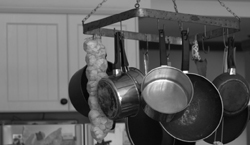
Hanging Pans in Kitchen by रोकावट के लिया खेदEarlier this week, I wrote about my ongoing challenge to organize the bits of paper and pixels in my life. The one category that I was most lost on was how to handle the many recipes and cooking ideas spread around my desk.

I have recipes in a plastic recipe box, in a 3-ring binder, and in a folder on my computer. I have some online recipes hidden in Delicious and others in my Food Network recipe box. I have a few in a wiki I tried to create as an online cookbook. And I have printouts stuck in various piles on my desk and in the kitchen. In short, I’m overrun with recipes, and I never know where the one I need is.

After a lot of thinking and advice from my friend Lisa Fink, who has her own online recipe collection, I decided to set up a blog specifically for recipes. After all, they really do not belong here with the teaching ideas.

I did a little research and found a WordPress plugin specifically for recipes, hRecipe. It adds in the headers and sections to keep the recipes consistent, and uses the hRecipe 0.22 microformat that optimizes the recipes for searching and classification. The microformat is used on the Food Network website as well as a number of other sites.

So if you’re interested in cooking, take a look at Tengrrl Cooks. There are only four recipes there so far, but they’re great ones:

Tell me what you think of the new site, and let me know if you have a favorite recipe I should try!


[Creative Commons licensed Flickr photo by रोकावट के लिया खेद]